
Hosein Pouriman, PhD, Packaging & Sustainability Expert ANZ
The Rise of Mono-Materials: A Strategic Guide to Recyclability and Cost Efficiency
For years, packaging innovation often meant more complexity -more layers, more coatings, more exotic materials, all fused together to maximize shelf life and graphic appeal. However, in the modern circular economy, this complexity has become a critical liability.
In my work auditing packaging portfolios, I have observed that the single most powerful trend in sustainable design today is a strategic return to simplicity: the rise of mono-materials.
For businesses in Australia and New Zealand, adopting a mono-material strategy is not just an environmental choice; it is one of the most effective commercial decisions you can make. It directly addresses the demands of our recycling infrastructure, aligns with evolving government regulations and builds the kind of brand trust that modern consumers demand.
This guide explores what mono-materials are, why they are the future of packaging in our region and how making the switch can deliver tangible benefits to your bottom line.
What Exactly is a "Mono-Material"?
A mono-material package is made from a single type of material. While this can refer to glass, aluminium or paper, the term is most often used in the plastics industry to mean packaging made from a single polymer.
The Mono-Material Example: A PET soft drink bottle (where the bottle, cap and label are all types of plastic that can be processed together or easily separated). A flexible pouch made entirely of Polyethylene (PE).
The Multi-Layer Composite (The Problem): A standard chip packet which is often a fusion of a plastic layer (like PP) and a metallic layer (aluminium). A long-life milk carton with layers of paperboard, plastic and aluminium.
While multi-layer materials are often engineering marvels of performance, they are the nemesis of our recycling systems. They cannot be mechanically separated, rendering them a contaminant that is almost always destined for landfill.
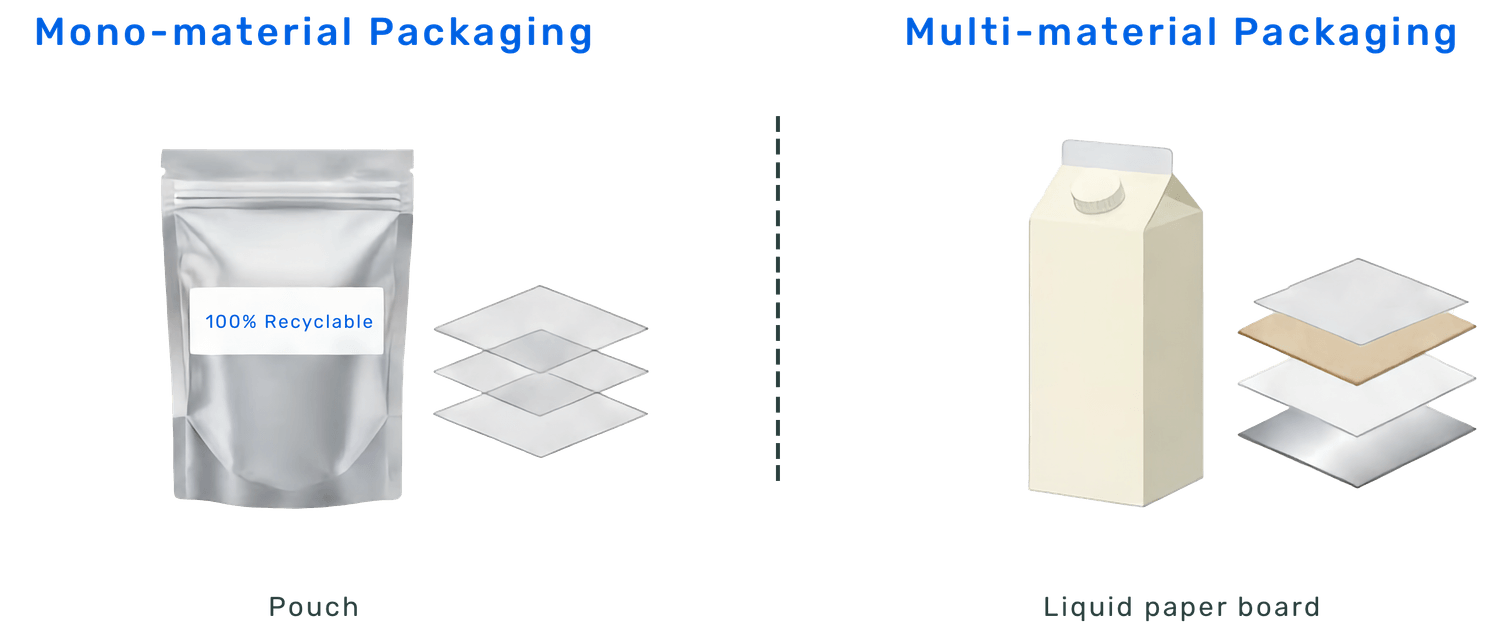
Comparison of two multi-layered food packaging. On left: all layers are made of Polyethylene (PE); on right: A generic liquid paper board (LPB) made of PE, paperboard, and aluminum foil. LPBs are generally made of 6 layers.
The Recyclability Advantage: Why Our System Loves Simplicity
To understand the power of mono-materials, you need to think like a Material Recovery Facility (MRF) -the sorting plant where our kerbside recycling goes.
These facilities are designed to quickly and efficiently sort common, high-volume material streams. They use advanced optical sorters that identify different types of plastic (like PET, HDPE and PP) and separate them into clean bales to be sold to recyclers.
How Mono-Materials Win: When a mono-material package -like a clear PET bottle or a PE pouch- goes through the system, the sorters can easily identify it and direct it to the correct stream. This results in a high-quality, uncontaminated bale of material that has real market value.
How Multi-Layers Fail: When a multi-layer package enters the system, the sorters cannot identify a single, clean material type. It is a contaminant. Unable to be sorted, it is typically dropped into the "residual" waste stream and sent directly to landfill.
This real-world performance is why mono-material designs are the key to unlocking a "Recyclable" rating in a PREP assessment and earning a clean Australasian Recycling Label (ARL).
The Business Case: Beyond Just Being 'Green'
Adopting a mono-material strategy delivers more than just a better environmental outcome. It is a calculated business move.
1. Future-Proofs Your Business and De-risks Compliance
As we have seen with the EU's PPWR, the global regulatory trend is moving aggressively towards "Recyclability at Scale." This means theoretical recyclability is no longer enough; packaging must be successfully sorted and recycled in practice. Mono-materials are perfectly positioned for this future, while complex multi-materials will be the first to face fees, penalties or outright bans.
2. Streamlines Your Supply Chain
Sourcing a single polymer from a supplier is often simpler and can be more cost-effective than procuring complex, multi-layered laminates from a specialist manufacturer. This can lead to simplified inventory management and more resilient supply chains.
3. Builds Unshakeable Brand Trust
In an era of intense scrutiny over greenwashing, simplicity is clarity. Being able to state unequivocally that your packaging is "100% PE and fully recyclable" is a powerful, honest and easily defensible claim. It allows you to use the ARL with confidence, giving your customers clear instructions and building deep brand trust.
Making the Switch: A Practical Approach
Transitioning to mono-materials requires careful planning and execution.
1. Audit Your Current Portfolio: The first step is to conduct a deep dive into your existing packaging. Identify every multi-layer or composite material you use and flag it as a risk.
2. Engage Your Suppliers: The packaging industry is innovating at a rapid pace. Speak to your suppliers about their latest high-performance mono-material films. New additives and manufacturing techniques are now creating mono-material solutions with barrier properties that can compete with traditional multi-layer plastics.
3. Test for Performance: The primary role of your packaging is to protect your product. You must rigorously test any new mono-material for shelf life, durability and transport stability to ensure it meets your performance standards.
4. Validate and Certify: Once you have selected a viable mono-material option, formalize your success. Commission a PREP assessment to get a technical ruling on its recyclability and earn the right to use the ARL on-pack.
The message from regulators, recyclers and consumers is clear: the future of packaging is simple. The move towards mono-materials is a strategic shift that aligns environmental responsibility with sound business sense, creating packaging that is ready for the circular economy of tomorrow.
Transitioning from complex materials to high-performance mono-materials can be a daunting technical challenge. Circular Blueprint specializes in auditing packaging portfolios, identifying viable mono-material alternatives and managing the supplier engagement and validation process to ensure a seamless and successful transition. Contact us today for a confidential consultation.
Is Your Strategy Ready for 2026?
Navigating the shifting regulatory landscape in Australia and New Zealand requires a plan, not guesswork. Download the free executive guide to:
- Master the new APCO targets.
- Optimise costs without sacrificing quality.
- Select the winning materials for the future.
Subscribe to our Email List
Get curated content delivered to your inbox.
No spams. Unsubscribe any time.


Expert packaging consultation focused on sustainability, compliance, and cost reduction for Australian and New Zealand businesses. Navigate complexity, achieve your goals.
Our Commitment
Helping Australian & NZ businesses achieve sustainable packaging goals, ensure regulatory compliance, and optimise costs for measurable results.
Circular Blueprint • NZBN 9429053436047
Privacy policy • Terms of service • All Rights Reserved