
Hosein Pouriman, PhD, Packaging & Sustainability Expert ANZ
Light-Weighting: The Strategic Approach to Cutting Material Costs and Carbon Footprint
In my work advising businesses on packaging strategy, I've found that companies are constantly searching for the next major innovation. Yet, one of the most effective and financially rewarding strategies is often overlooked. It isn’t a revolutionary new material, but a disciplined engineering process: light-weighting.
Light-weighting is not, as some assume, simply about making packaging weaker or flimsier. It is the precise, data-driven science of systematically removing excess material from a package—be it glass, plastic, or paperboard—without compromising its primary function of protecting the product.
For any business that manufactures or ships physical goods in Australia and New Zealand, adopting a light-weighting strategy is a powerful lever for change. It delivers a direct and measurable reduction in both operational costs and environmental impact. Let us explore the mechanics of how this is achieved.
The Hidden Tax of Over-Packaging: A Common Business Blind Spot
The vast majority of products on the market today are, to some extent, over-packaged. This is rarely intentional. It is the slow accumulation of legacy design choices, overly cautious specifications, and a general reluctance to alter a package that is perceived as "working."
This results in a hidden tax being paid on every single unit shipped:
The Glass Jar: A food producer’s glass jar may have walls that are millimetres thicker than required, a legacy from a time when glass manufacturing was less precise.
The Cardboard Carton: A shipping box may be specified with a heavy-duty twin-cushion board to carry 25 kg, when the product inside only weighs 10 kg and is never stacked more than five high.
The Plastic Bottle: The bottle cap and neck finish may be based on a design from a decade ago, ignoring modern innovations that use significantly less polymer for the same sealing performance.
Each of these examples represents a daily, recurring cost—a tax on unnecessary material, unnecessary weight, and unnecessary carbon emissions. The light-weighting process is a systematic approach to eliminating this tax.
The Compounding ROI of a Light-Weighting Strategy
A properly executed light-weighting project delivers a cascade of benefits that compound across the entire supply chain. The business case is compelling because the savings are tangible and recurring.
1. Direct Material Cost Reduction
This is the most immediate financial benefit. Packaging materials are predominantly purchased by weight.
The Problem: A business is paying for every gram of material in its packaging. Excess thickness in a plastic film or an unnecessarily high grade of paperboard directly inflates the cost of every unit.
The Solution: A light-weighting project identifies the precise minimum amount of material required to meet performance standards. A 10% reduction in the weight of a glass jar, for example, can lead to a near-equivalent reduction in its unit cost. When multiplied by hundreds of thousands of units, these savings become substantial.
2. Reduced Logistics and Freight Costs
This is where the financial benefits multiply. The design of your package has a profound effect on your entire logistics network.
The Problem: Heavier packaging not only increases the direct cost of shipping but can also be dimensionally inefficient. This leads to poor pallet utilisation, meaning fewer products fit into a truck or shipping container.
The Solution: Lighter packaging inherently costs less to transport. Furthermore, the design process often results in slight dimensional adjustments that can dramatically improve pallet density. Being able to fit an extra layer of product onto every pallet can eliminate a significant number of truck journeys per year, slashing both freight costs and associated carbon emissions.
3. Enhanced Sustainability Credentials and Compliance
In today's market, sustainability is a commercial imperative. Light-weighting is a direct and quantifiable way to improve your environmental performance.
The Problem: Over-packaging consumes excess virgin resources and generates a larger carbon footprint. This is a direct contradiction of the principles outlined in the APCO Sustainable Packaging Guidelines (SPGs) and can be a point of weakness in a company's annual reporting.
The Solution: Using less material directly reduces the energy, water, and raw resources consumed in production. This creates a powerful, data-backed sustainability story that resonates with customers, retailers, and stakeholders. It is a clear demonstration of a commitment to Principle 1 of the SPGs: Design for Resource Efficiency.
A Practical Guide: The Light-Weighting Process in Action
A successful light-weighting initiative is a formal engineering project, not a casual cost-cutting exercise. It requires a structured approach.
Step 1: The Data-Driven Audit
The process must begin with a deep analysis of the current state. This involves a full specification review of all packaging components and mapping the product's journey to understand the real-world stresses it endures.
Step 2: Supplier Collaboration and Material Innovation
Your packaging suppliers should be treated as technical partners. They possess deep knowledge of the latest material innovations, such as advanced polymers that offer higher strength at lower thicknesses, or new flute designs for corrugated board that provide the same stacking strength with less paper fibre.
Step 3: The Critical Testing Phase
This is the most important step and it is non-negotiable. Reducing material cannot come at the expense of product protection. Any new, lighter packaging design must undergo a rigorous testing protocol to validate its performance. This includes:
Transit and Vibration Testing: Simulating the journey via truck or rail.
Drop Testing: Ensuring impact resistance.
Stack and Compression Testing: Verifying its ability to withstand warehouse stacking.
Step 4: Phased Implementation and Monitoring
Once a new design is validated, it should be implemented in a controlled manner. A phased rollout allows for real-world monitoring to confirm performance before a complete changeover, de-risking the entire process.
Conclusion: From an Expense to an Efficiency Driver
It is time to view packaging not as a static cost, but as a dynamic system that can be optimised for performance. Light-weighting is the epitome of this thinking. It is a strategic imperative that aligns financial prudence with environmental responsibility.
By systematically challenging the status quo of your packaging designs, you can uncover significant opportunities to reduce waste, cut operational costs, and build a more efficient, resilient, and sustainable business.
While this guide provides a strategic framework, successfully implementing a light-weighting project requires deep technical expertise in materials science, supply chain dynamics, and performance testing. For businesses seeking to navigate this complex process, a formal audit is the logical first step. If you would like to discuss the specific opportunities within your packaging portfolio, our door is open. Contact us today.
Resources of this topic:
APCO - Sustainable Packaging Guidelines (SPGs): https://apco.org.au/sustainable-packaging-guidelines (Principle 1, "Design for resource efficiency," is the core of light-weighting).
O-I Glass - Sustainability Report: https://www.o-i.com/sustainability/ (Major manufacturers like O-I, a global leader in glass, frequently publish reports and case studies on their successful light-weighting initiatives).
International Safe Transit Association (ISTA): https://www.ista.org/ (The global authority on transit packaging performance testing. Their standards are the benchmark for validating new, lighter designs).
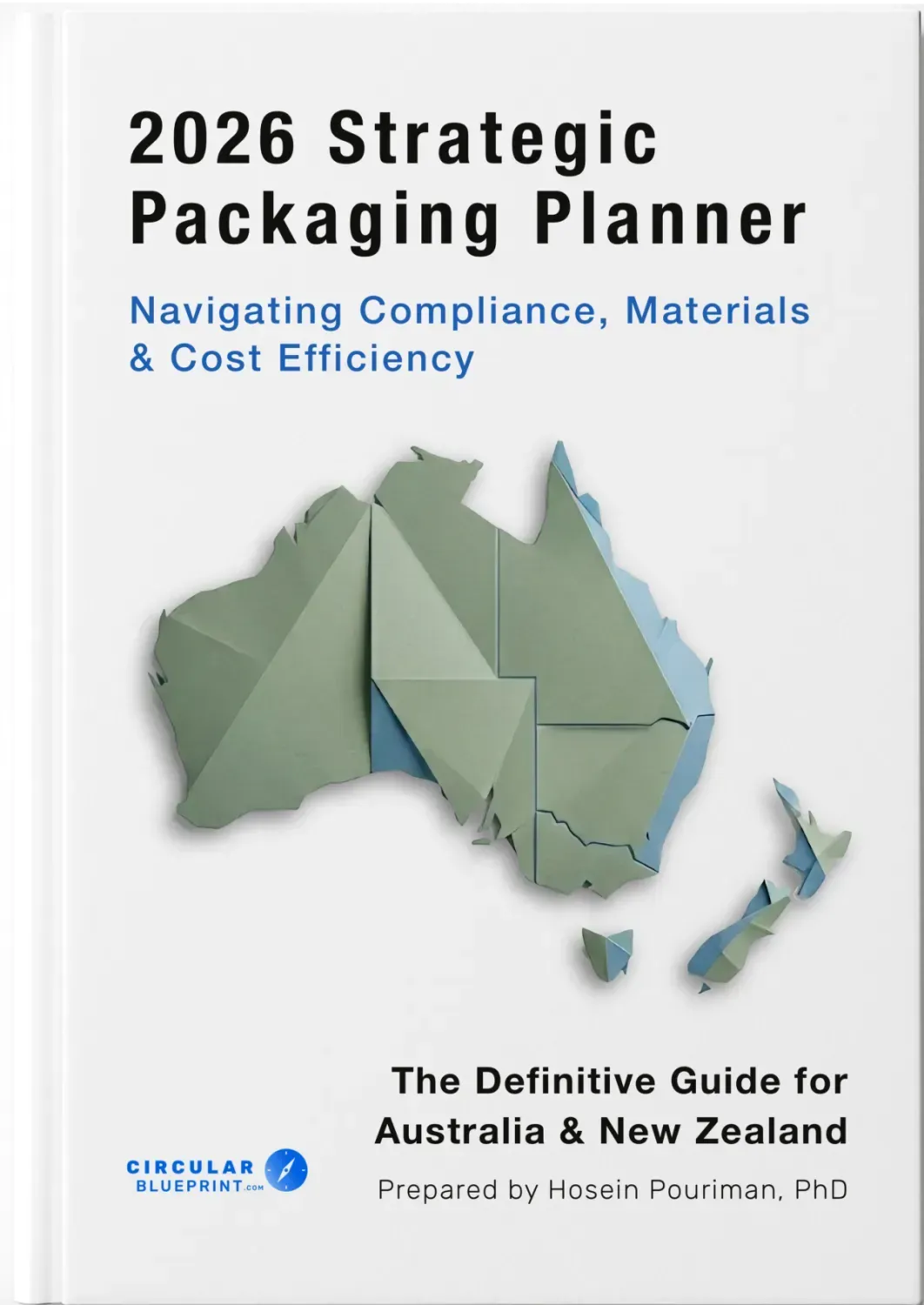
Is Your Strategy Ready for 2026?
Navigating the shifting regulatory landscape in Australia and New Zealand requires a plan, not guesswork. Download the free executive guide to:
- Master the new APCO targets.
- Optimise costs without sacrificing quality.
- Select the winning materials for the future.
Subscribe to our Email List
Get curated content delivered to your inbox.
No spams. Unsubscribe any time.


Expert packaging consultation focused on sustainability, compliance, and cost reduction for Australian and New Zealand businesses. Navigate complexity, achieve your goals.
Our Commitment
Helping Australian & NZ businesses achieve sustainable packaging goals, ensure regulatory compliance, and optimise costs for measurable results.
Circular Blueprint • NZBN 9429053436047
Privacy policy • Terms of service • All Rights Reserved